Viata Webinar: Meridian Balancing For Beginners
This Webinar is divided into 8 modules:
Module 1: Introduction & Foundational Principles
Module 2: Major Meridian Pathways
Module 3: Yin/Yang Balance in the Meridians
Module 4: Daily Energy Balancing Routine
Module 5: Emotions & Meridians
Module 6: Self-Testing for Meridian Imbalances
Module 7: Hands-On Balancing Techniques
Module 8: Integration & Personal Practice
Module 1 – Introduction & Foundational Principles:
Hello and welcome to Viata’s eight‑part Beginner Meridian Balancing webinar. If you are new to Meridians and Meridian Balancing, and want to understand, feel and learn to balance your own meridians for better health and vitality – you are in the right place!
In this webinar, we are going to explore how energy flows through the body, how to recognize when it’s out of balance, and most importantly, how to bring it back into harmony. Think of this as learning the language of your energy system—the rivers, streams, and brooks of life force that sustain every cell, every organ, and even your thoughts and emotions. This webinar will present practical tools and clear explanations, providing you with the necessary information to begin your own Meridian Balancing routine. Balanced Meridians keep us feeling vibrant, centered, and healthy.
What are Meridians?
Meridians are energy channels that flow throughout your body. Imagine meridians as invisible pathways of life force flowing through you. In Traditional Chinese Medicine, they are considered the pathways that carry qi or life force. Just like blood flows through veins, qi/life force flows through meridians.
The Meridians are the body’s integrative network – a hidden lattice of energy channels that link all aspects of our being – our physical, mental, emotional & spiritual. This means every facet of who we are – from our toes to our head and everything in between, as well as our thoughts, emotions, memories, dreams, and beliefs are connected through this energetic meridian system. The meridians are invisible conduits, weaving together our physical form and our subtle, non‑material dimensions into a unified, communicating whole.
When meridians are balanced, vitality reaches every cell and you feel energized, emotionally stable, and physically healthy. But when meridians are blocked or out of balance, energy stagnates and you may feel tired, anxious, or even develop physical symptoms like headaches, digestive issues, illness or pain.
Origin of Meridians:
Although Meridians may not be a household word in the West, that is not the case for billions of people in other parts of the world. For thousands of years, people in the East have been utilizing Meridian therapy to restore Health and Wellness. Generations have been raised with this knowledge. Some historians report the knowledge of meridians dating back to over four thousand years ago. The earliest systematic written description found of the meridian system appears in ancient Chinese texts dating back over two thousand years ago (2nd century BCE). The “Yellow Emperor’s Inner Canon”, a Chinese Medicine classic, goes into further detail than previous texts about the meridian system and it also was compiled over two thousand years ago – around the 1st century BCE. So lets get more familiar with this ancient energetic system.
The Importance of Energy Flow and Sensing Energy Flow:
Think of meridians like rivers. When a river flows smoothly, the land around it is nourished and fertile. But when the river is blocked or dried up, the land suffers.
The same is true for your body. Clear energy flow nourishes your cells, mind, and spirit. Blocked flow creates stress, tension, and imbalance.
Our goal in this webinar is to help you notice your energy flow, recognize blockages, and practice simple ways to restore harmony.
Guided Practice – Sensing Energy Flow
Let’s do the first exercise. You won’t need any special tools, just your awareness.
Sit comfortably, close your eyes if that feels good.
Take three slow breaths, in through the nose, out through the mouth.
Now, bring your attention to your body. Notice if any areas feel tight, heavy, or tense.
Then notice if there are areas that feel light, open, or flowing.
Imagine energy, like a gentle stream of light, or a gentle flow of water, flowing from the top of your head down to your feet.
Where does it move smoothly? Where does it slow down or feel stuck?
This is your first step in sensing your own meridians—simply noticing.
Recognizing Imbalances:
How you might recognize a meridian imbalance in daily life:
Physical signs can include fatigue, pain, or digestive upset.
Emotional signs may look like irritability, sadness, or anxiety.
Even mental signs appear, like brain fog, overthinking, or indecision.
All of these are signals from your energy system that something is out of balance. And the good news is—you can bring it back into balance.
Summary:
In Module 1, you’ve learned the foundation: what meridians are, why they matter, and how to begin sensing your own flow.
In the next module, we will map the 12 major meridians, discover which organs and emotions they connect to, and begin practicing simple ways to trace and balance them.
Home-Health Fun:
Between now and the next module, I invite you to spend just a few minutes each day quietly scanning your body—asking, ‘Where does my energy feel open, and where does it feel blocked?’
This awareness alone begins the healing process. Thank you for joining me today. I’ll see you in Module 2.
Module 2 – The 12 Major Meridians + 2 Central Vessel Meridians: Your Energy Pathways
Welcome back to our webinar Balancing the Meridians Beginner’s. In Module 1, we introduced the concept of meridians as the energy rivers of the body. In Module 2, we’ll explore the 12 major meridians, each connected to an organ, an emotion, and specific physical and mental functions. By the end of this module, you’ll have a map of your energy system—a clear picture of how energy flows and where blockages may arise.
Overview of the 12 Primary Meridians + 2 Central Vessel Meridians
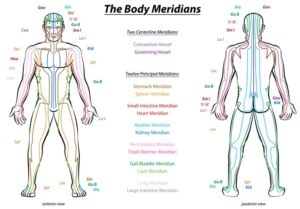
The body has 12 primary meridians and 2 Central Vessel Meridians. Each of the 12 Main Meridians corresponds to an organ system, but remember: when we say ‘organ’ here, we mean the energetic function as well as the physical organ.
12 Major Meridians & 2 Central Vessel Meridians:
Lung Meridian – governs breathing, immunity, and the emotion of grief.
Large Intestine Meridian – supports elimination, letting go, and emotional release.
Stomach Meridian – digestion, nourishment, and worry when out of balance.
Spleen Meridian – assimilation, blood production, and overthinking.
Heart Meridian – circulation, joy, love, and clarity of mind.
Small Intestine Meridian – digestion of food and sorting truth from falsehood.
Bladder Meridian – fluid balance, flexibility, and release of fear.
Kidney Meridian – life force, willpower, courage, and deep fears.
Pericardium (aka Blood Circulation) Meridian – protector of the heart, governs relationships and emotional safety.
Triple Burner/Warmer/Heater Meridian – regulates body temperature and fluid distribution.
Gallbladder Meridian – decision-making, courage, and releasing resentment.
Liver Meridian – detoxification, vision for the future, and anger when blocked.
Conception Vessel Meridian – Governs all the Yin Meridians, Mainly associated with the Kidneys (yin), Uterus, Liver & Spleen Organs. Main functions involved in: fertility, conception, pregnancy, menstruation, nourishing yin, blood & body fluids, regulating the chest & abdomen.
Governing Vessel Meridian – Governs all the Yang Meridians- Stomach, Bladder, Gallbladder, Small Intestine, Triple Burner). Mainly associated with the Kidneys (yang), Brain, Heart and Spine. Main functions providingYang QI to the entire body, spinal health, nervous system, mental functions, defense/immune system. Especially important in mental clarity, memory, and emotional stability.
*** Together, the Conception Vessel Meridian (yin) and Governing Vessel Meridian (yang) form the yin-yang axis of the body, regulating reproduction, growth, vitality, and the balance of yin and yang energies.
Organ & Emotion Link
Each meridian not only supports the body but also carries an emotional tone.
For example:
A blocked Lung meridian may show up as prolonged sadness or difficulty letting go.
A stressed Liver meridian can create irritability, frustration, or even headaches.
A weak Kidney meridian may bring about fearfulness, insecurity, or lower back pain.
This connection between body and emotion makes meridian balancing an amazingly powerful tool.
Guided Practice – Simple Tracing
Let’s do a simple technique called Meridian Tracing.
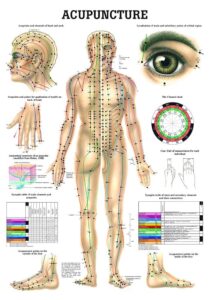
**See Meridian Body Charts above for reference
Place your hand just above your chest.
With a sweeping motion, trace down the inside of your arm all the way to your thumb. This is the Lung meridian.
Now from your index finger, trace up the outside of the arm toward the shoulder and across the face. This is the Large Intestine meridian.
Home-Health Fun:
Between now and then, I invite you to continue spending a few minutes each day quietly scanning your body—asking, ‘Where does my energy feel open, and where does it feel blocked? In addition, do Meridian Tracing along all 12 main meridians as well as the 2 Central Vessel Meridians. You won’t be able to physically trace the meridians on your back, yet you can visualize those parts of the meridians. With continued practice your discernment of open and blocked meridians will greatly improve.
Summary: We mapped the twelve meridians and learned how they connect body, mind, and spirit. In our next module, we’ll explore the relationship of yin and yang—the complementary forces that keep these meridians in balance.
Module 3: Yin and Yang Balance in the Meridians
Welcome to Module 3. In this module, we will explore the principle of yin and yang, and why this balance is essential for healthy meridians.
Every meridian has a partner—one yin, one yang. Just like night and day, or inhale and exhale, these forces depend on each other.
Yin versus Yang
Yin is cooling, nourishing, and inward.
Too much yin might feel like fatigue, coldness, or lack of motivation.
Yang is warming, activating, and outward.
Too much yang might feel like anxiety, inflammation, or restlessness.
Pairs of Meridians:
The meridians are paired in yin/yang relationships. For example:
Lung (yin) ↔ Large Intestine (yang)
Spleen (yin) ↔ Stomach (yang)
Heart (yin) ↔ Small Intestine (yang)
Kidney (yin) ↔ Bladder (yang)
Liver (yin) ↔ Gallbladder (yang)
Pericardium (yin) ↔ Triple Burner (yang)
When one is out of balance, its partner will also be affected.
Guided Practice – Palm Balancing
Let’s try a simple balancing technique.
Place the palm of your left hand over your chest, and the palm of your right hand over your lower abdomen.
Take three deep breaths. Feel the upper and lower body connecting.
Switch hands and repeat.
*This helps balance yin and yang energies in your body.
Home-Health Fun:
Between now and the next module, I encourage you to continue spending a few minutes each day quietly scanning your body—asking, ‘Where does my energy feel open, and where does it feel blocked? Also continue doing the Meridian Tracing along all the meridians easiest for you to reach. See if you can feel a difference between the “yin” and “yang” meridians.
Summary: In this module you learned how yin and yang are expressed in your meridians, and how to begin balancing them. In Module 4, we’ll put all this together in a simple daily energy routine.
Module 4 – Daily Energy Balancing Routine
Welcome to Module 4. Today you will learn a 10-minute daily routine to keep your meridians flowing freely. Think of this as brushing your energetic teeth.
Daily Guided Practice – Simple Daily Energy Routine
Thymus Thump – Tap gently with a lightly closed fist. Make contact with flat part of your fingers – NOT your bent knuckles. Tap at the center of your chest for 20 seconds. This boosts immunity. See figure 1 below.

Fig. 1: Thymus Thump-Tap
2. Lymphatic Massage – ** ALWAYS use Very light feather-like touch & pressure, and slow, controlled movements. & keep your hands soft and relaxed. Use just enough pressure to gently stretch the skin as far as it naturally goes and then release the pressure and let your skin come back as it was. If you can feel your muscles underneath your fingers, then you are pressing too hard. Use the flats of your hands instead of your finger tips. This allows more contact with the skin to stimulate the lymph vessels.
Rub above & below the collarbones and along the ribcage. This clears toxins. To massage this area, place the pads of your fingers just above the collarbone in the hollow area, and place your thumbs just below the collarbone. Gently stretch/push the skin toward the sternum in a “J” shape motion, holding for a few seconds before releasing. This should be repeated 10 to 15 times on each side. For the upper body, including the area between the ribs, remember feather-like touch – move from the periphery toward the center and upward to encourage fluid movement. It is crucial to perform these techniques with light pressure, as the lymphatic system is sensitive, and deep or forceful strokes can be counterproductive.
See figures 2a & 2b below.
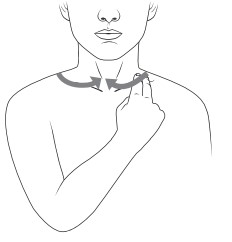 Fig. 2a: Above Collar bone massage
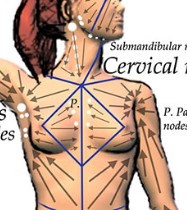
Fig. 2b: Chest & Ribcage Lymph massage
Cross Crawl – March in place, touching opposite hand to knee. Raising the right arm and left leg simultaneously, then the left arm and right leg, while turning the head toward the raised arm. This balances left and right brain.This movement is believed to strengthen neural connections, improve hand-eye coordination, and support reading and learning abilities Fig.3: Cross Crawl.

4. Meridian Tracing – Sweep your hands along the body following the flow of energy.
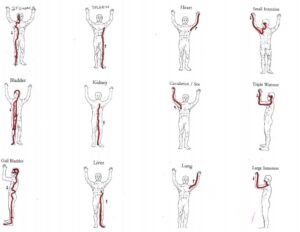
Fig. 4: Meridian Tracing
5. Grounding Breath – Stand with feet hip-width, breathe deeply in through your nose and out through your mouth, and imagine roots growing from your feet into the earth.

Fig: 5: Grounding Breath Stance
Home-Health Fun:
Practice the Simple Daily Energy Routine (steps 1-5 above) at least once a day. Optimal is twice a day – once in the morning and then again at bedtime. Anytime you are feeling off, is also a great time to do the routine.
Summary: This daily practice clears blockages, strengthens flow, and sets your energy for the day. In Module 5, we’ll connect emotions directly to meridians.
Module 5 – Emotions & Meridians
In this module, we’ll explore how emotions live in your meridians—and how you can release emotional stress by balancing energy.
Emotion – Meridian Connections:
Stress and frustration often overload the Liver and Gallbladder.
Grief and sadness sit in the Lung.
Fear shows up in the Kidneys.
Worry and overthinking strain the Spleen.
Joy—when balanced—lives in the Heart.
When emotions linger too long, they block energy flow. By gently resetting the meridian, we can also release the emotional heaviness/stagnation.
Guided Practice – Lung Release:
Let’s practice with the Lung meridian.
Place one hand on your chest.
Take a deep breath in.
Exhale with a gentle sigh.
Tap lightly on your chest while thinking of something you are ready to let go of. Do this gently until you notice your body softening and your Lung Meridian opening.
Home-Health Fun:
Continue to do the Simple Daily Energy Routine 1-2 times a day. Additionally, do the Lung Meridian release (above) 1-2 times a day. Follow with 5 long slow deep breaths. Notice if it uplifts your mood.
Summary: Emotions are not problems—they are signals. Understanding the Connect between emotions and specific meridians, allows you to literally shift your energy in minutes through quick meridian resets. In Module 6, we’ll learn how to recognize which meridian is calling for your attention.
Module 6 – Self-Testing for Meridian Imbalances
Welcome to Module 6. Now that you know the meridians, let’s learn how to recognize imbalance in your own system.
Signs of Imbalance:
Physical: pain, tension, digestive upset.
Emotional: fear, grief, frustration, sadness, anxiety.
Mental: overthinking, brain fog, indecision.
Guided Practice – Body Scan Journaling
Let’s try this:
Close your eyes.
Slowly scan from head to toe.
Notice any tension, temperature differences, or emotions.
Write down your observations.
This is your first self-diagnostic tool—simply noticing = ‘listening’
Summary: “Your body “whispers” before it “shouts”. Meaning the body always sends us subtle clues/messages when things are off. If we don’t hear/notice, then the clues/messages get louder, bigger, more drastic until we notice and do something to restore balance. The more you listen/are aware, the easier meridian balancing becomes. In Module 7, we’ll explore hands-on techniques for realignment.
Module 7 – Hands-On Balancing Techniques
This module is practical and hands-on. We’ll use touch, movement, and sound to balance meridians.
Guided Practice:
Acupressure Hold – Yin-Yang Hold: Place the palm of one hand on the forehead and the palm of the other hand on the back of the head. This calms stress, nerves, anxiety.
Meridian Massage: Rub along sore spots on the ribcage or thighs—these are neuro-lymphatic reflex points.
Stretch: For the Liver meridian, stand tall, place hands overhead, and stretch to the side while exhaling with a ‘shhhh’ sound. This is especially helpful for irritation, anger, frutration.
Summary: Touch, stretch, and sound are powerful tools for clearing stagnation. In our final module, we’ll integrate everything into your personal practice.
Module 8 – Integration & Personal Practice
“Congratulations—you’ve made it to Module 8! In this module, we’ll bring everything together into a personalized routine.
Integration – Putting all the parts together into one cohesive personalized routine.
You now know:
The 12 meridians.
Yin and yang balance.
Daily energy practices.
Emotional connections.
Hands-on balancing techniques.
So, Now it’s time to create your own 15-minute daily ritual.
Guided Practice – Full Session
Final integration for 15-minute daily ritual:
Thymus thump.
Collar bone and ribcage Lymphatic massage.
Cross crawl.
Trace all meridians.
Emotional release breath.
Yin/yang palm hold.
Grounding visualization.
Take a deep breath. Notice how you feel now compared to when we started this journey.
Summary: Balancing your meridians is not a one-time event—it is a lifelong practice. Initially that might sound like a lot, but when you experience the profound impact this 15 minute daily exercise actually has on your overall Health & Happiness – you realize what a huge benefit you’re receiving for such a small commitment. In business terms your return on investment is huge!
As you continue with this daily practice, your ability to listen to and understand your body will become more refined. You will be able to notice more subtle things, and you will notice them sooner. Having this level of self awareness paired with your meridian balancing tools, equips you with an amazing shield of prevention.
Thank you for joining me in this 8-module journey. May your energy flow with ease, your emotions stay balanced, and your spirit remain vibrant.